Instruction unclear…

We are still (how long does the land shark stage last?!) trying to convince our puppy that body parts are not chew toys and that he is not to ‘mouth’ us. That’s such a cute term to have a carnivorous predator with a mouth full of needle sharp teeth latch onto your extremities and gnaw on you. When we asked the trainer (still not convinced she isn’t three dogs in a trenchcoat) about how to stop this without resorting to either a muzzle or water spray bottle or possibly chain mail (for us not him) she suggested that instead of reacting to being impaled by multiple sharp pointy objects we ‘play dead’. By which she meant that we allow the limb he grabbed hold of to go limb and uninteresting while waving a ‘legal’ chew such as a toy or nylabone in his face with the other hand. 

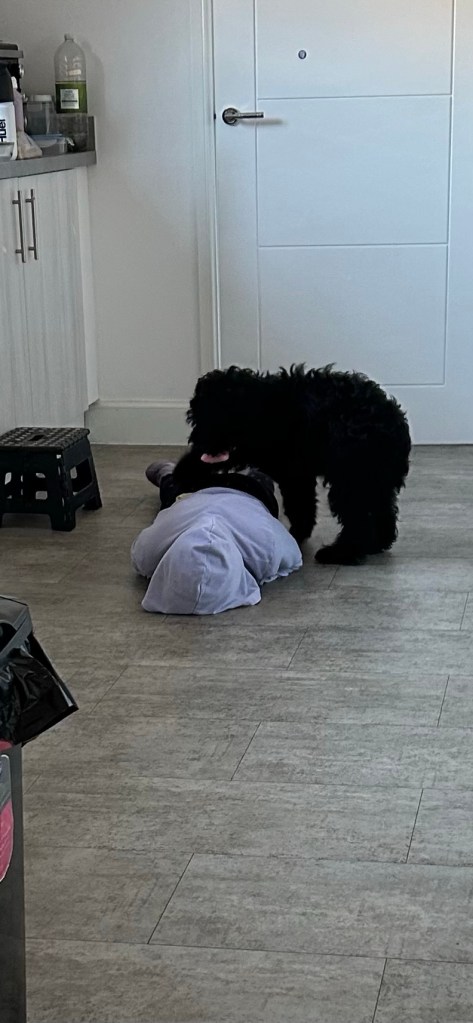
That’s all very well but he prefers chewing on the squishy body temperature bits. She asked us to explain this to our fae, which we did. She locked on to the ‘play dead’. That bit she got sort of, to the point where I heard her snap ‘no’ at the dog, followed by a thump and some scrabbling. When I turn around she is laying on the ground, completely face planted like a planking statue while the puppy scrambles around trying to determine if this is some sort of game, a threat or if some awful ailment has just overcome his favourite playmate. I needed to leave to stop laughing. On the plus side it did stop him mouthing so I guess it worked, on the down side she now makes like a swoons like a Victorian heroine if he even opens his mouth. 

So yes endless treats is a successful training tool but apparently confusion works just as well. 

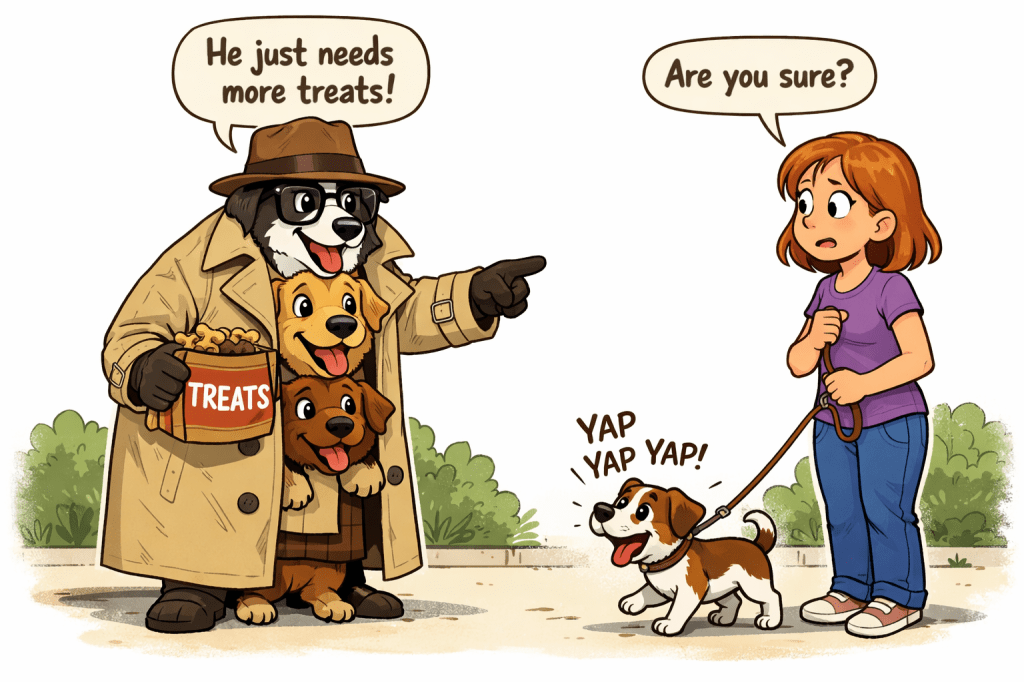
Three Dogs in a Trenchcoat

Because we have questions over how to train our puppy to be a service dog, and frankly how to train it so it doesn’t eat its own poop and to come back when called we hired a trainer. 

She’s a lovely lady who is accredited to train therapy dogs, great. She is local and happy to work with us, wonderful. She only uses positive behaviour training, perfect. However my husband is beginning to suspect that she is in fact three dogs in a trench coat. The reason for this is that the answer to any question, training issue or problem seems to be the judicious application of treats. Needless to say the puppy loves it when she visits. It doesn’t matter what you want to do with your pup it seems the answer is make sure you have an endless supply of treats. 

Do you want your pup to sit? Use a treat. Do you want them to come? Hold a treat? Do you want them to leave something? Hold a treat and THEN give them two treats from the other hand for leaving the single treat alone. Today trainer wanted to teach us ‘positive interference’ this is a technique to use when puppy is ‘mouthing’ (she says mouthing it feels like biting) someone. It’s very straightforward, when puppy is mouthing you to ribbons you chirp happily ‘to the fridge’ and skip to the cooler, where you give pup a yummy treat – ham, cheese etc, to interrupt the behaviour. 

So there you have it, puppy biting? Give them a cold treat. Puppy not biting give them a room temp treat. Puppy crying in crate give many treats. 

So yeah, three dogs in a trenchcoat. 

Safeguarding is not optional 2

So it’s been a few days since I quite impressively lost the plot at the gym over the complete failure to safeguard the kids club. To the credit of the Activities Manager, he emailed me on the Sunday assuring me he would follow up. I shot an email back asking two main questions: how did this happen; and how will you stop it happening in future? 

I’m not after freebies, I’m not after complementary meals or activities. I want to know that my daughter is safe in the one club that she loves to attend.

I heard nothing back.

I checked with reception, the activities manager was not in for a couple of days but returned to work on Thursday. Unfortunately for him, I too return to the gym on Thursdays. Twice. Once in the morning for my own session, and once in the evening for my daughter’s club.

This means I can start putting the ideas out there that I’m still wanting answers in the morning and expect them in the evening. I would feel sorry for them, but hey, that’s why managers get the big bucks, right? 

Sure enough, I managed to track him down a few moments ago, and to my amazement he had some answers for me. Most of them were (as expected with management) throwing other staff under the bus, but there have been some changes: he has ordered more radios so that there are spares – apparently there is a shortage of radios which only came to light because of my hissy fit. He looked horrified by this. He also admitted that there would be no more pickleball tournaments (the phrase “never again” may or may not have passed his lips but it was definitely in his eyes) and the staff have been ‘reminded’ of what other actions they could have taken. Next time if there is any sort of event like that it will be on other courts far away from the Kids Club. 

So, all in all, there has been some positive progress, some positive changes, and hopefully he will stand by his vow of never again.

Although I would love to know what the actual story circulating in the staff room is, as my trainer took one look at me this morning and asked with a grin ‘So, what happened Sunday?’ 

Looks like I’m the subject of the back room tea this week.

Ah well. 

Safeguarding is not optional

So I have made myself rather unpopular at my local gym which is unfortunate as we rather like the place. The thing is, I don’t – and won’t – mess about when it comes to the safety of my child, and I’m frankly surprised at the number of parents who either don’t realise, or have blind faith that someone else will sort, situations that are blatantly unacceptable.

Last Sunday, as with every Sunday, my daughter had Kids’ Club at the gym. She also has Kids’ Club on Wednesdays, Thursdays, Saturdays and most holidays. So, safe to say, we are here a lot. But, this particular day, most of the courts in the facility had been taken over for a pickleball tournament. 200 people from other clubs and various areas had descended onto the club, and it was beyond capacity.

Someone hadn’t done the maths and there was not enough space for them all. So a genius had decided that the Kids’ Club only really needed half a court, and it was perfectly fine for all these strangers to be hanging around/playing on the same court as 30 children. This Kids’ Club has rules on safeguarding where they won’t even let parents stay because we are not DBS checked by the club but it’s perfectly fine for 200 (not necessarily even members) to be on the court with them.

No.

Not only that, when I questioned the staff leading the Kids’ Club over what the hell was going on, they didn’t even have a radio to call for help! 

Now you might think ‘what’s the big deal about that?’ Those radios are how the staff call parents down if there is an issue, call for first aid, or clean up. In fact, in the two years we have been attending I can’t think of a session where they haven’t been used so the idea of them running a session, particularly a chaotic one like this without support is insane. 

I might have got annoyed, pulled a full ‘internet Karen’ and demanded to speak to a manager. This scared the reception staff who didn’t realise there had been a court invasion and couldn’t get a manager to appear fast enough. When I asked him – politely – what on Earth was going on, he claimed he didn’t know.

That’s easily fixed – I dragged him (metaphorically, but he did look like I got hold of his ear and twisted it) down to the courts and showed him. He did an impression of a guppy and agreed that it wasn’t on. When I started using phrases like ‘duty of care’ and ‘safeguarding’ he immediately found the Kids’ Club a radio (amazing) and ordered the court cleared (why did this take me intervening?)

Through all of this, with me standing there making demands of space for the kids, and that their staff were given the equipment they needed, it took 20 mins to be sorted. By the end I was shaking and trying to control a panic attack, and all I could think was ‘why am I the only parent complaining?!’ Every other parent seemed to think that whining at the Kids’ Club staff was the acceptable thing to do and then went away grumbling. 

If you can see the situation isn’t acceptable, why are you accepting it? Why are you not stamping your feet and saying no? Why am I standing alone and saying ‘Will someone please think of the children?!’

…ok that was a bit dramatic. 

More importantly, how are you comfortable leaving your child in an environment that has already made you feel twitchy – I can’t do it, I have to make it safe, despite knowing it embarrasses the hell out my daughter. Yes, I know that 99.9% of the time there isn’t a problem and there isn’t a single person in that tournament that would do / say something untoward to a child.

But that 0.1% exists and to pretend they don’t is naive to the point of recklessness. We have safeguarding for reasons, and you might say that it will never happen, but I’m sorry, history proves you horribly wrong. 

There is no such thing

This is going to upset a lot of people who think this is gatekeeping, but it needs to be said.

I don’t think there is such a thing as being “a little bit autistic”. Or a little bit ADHD. Or a little bit OCD. Or a little bit any other form of neurodivergence. You either are, or you are not. You cannot have “a bit of ’tism”, so please stop saying it. Stop saying things like “well, we’re all a bit on the spectrum.” No. We are not. That is not to say that ASD isn’t a spectrum, it is but saying everyone is on it is like saying because everyone has eyes everyone needs glasses. It doesn’t make sense and it simple isn’t true.

If everyone were, the world would look very different.

If the people who make the laws, rules, and decisions were autistic, life would not be an endless assault of forms that make no sense, contradictory instructions, arbitrary deadlines, and questions that could have been answered by reading the information already provided. Systems would be logical. Paperwork would be clear. Processes would work. Instead, navigating modern life often feels like a particularly cruel escape room designed by someone who hates you.

Lights would also be banned from flickering. Entirely.

If you don’t notice that LED lights flicker at around 50Hz—or that electricity itself makes noise—I envy you deeply. If everyone became distressed by background music, there would be strict limits on volume in public spaces. Fifty decibels max for non-essential audio systems. No tinny pop music bleeding into your skull while you’re just trying to buy milk. No surprise soundtracks in shops. Peace would reign.

Changing a shop layout overnight would be illegal. Menus would not suddenly change format for “fun”. Any “new and improved” recipe would require a clearly labelled phasing-in period of at least a year, and manufacturers would be legally obligated to announce packaging changes well in advance so nobody accidentally bought the wrong thing and had their entire week ruined by a different texture.

It would also be entirely acceptable to leave a meeting because someone was wearing strong perfume, cologne, or simply smelt. Makeup would no longer be considered the default expectation for women, but an option—because for some of us it feels like clawing our own skin off and suffocating at the same time. That’s not a feminist statement. That’s a sensory one.

So no, not everyone is “a little bit on the spectrum”.

Liking your books lined up neatly does not make you OCD. Enjoying organisation does not mean you have a debilitating, intrusive, anxiety-driven condition that can consume your life. Saying it does is insulting to people who actually live with it.

Neurodivergence is not fun. It is not a quirky personality trait. It does not give you magical memory powers, and it is not a free pass to be rude, cruel, or socially inappropriate. Being autistic is not a get-out-of-jail-free card for bad behaviour.

You still have to learn how to behave. You still have to learn what is acceptable.

We have started explaining this to our fae child: yes, her way may be logical, but humans expect a certain level of decorum, and she needs to learn how to pass as one. Is that unfair? Absolutely. Is it necessary for her safety and ability to exist in the world? Also yes.

Does this get us strange looks? Of course.

Does she adjust her behaviour in public?

…Well. I remain hopeful.

Merry Christmas to all—a strange human tradition involving killing trees and exchanging brightly wrapped parcels. This one, at least, my fae loves.

SEND tax

I have finally found—after, I admit, a lot of searching (to the point that Meta’s algorithm eventually cottoned on to what I was looking for)—a charity to help us train our puppy into a reputable service dog. They’re recognised by the government and the NHS, so yay. They also charge north of £3,000 per annum to support training.

Three grand. To help train a dog.

They do say you might be able to get funding via the NHS, various grants, or DLA—provided you have the correct words on the EHCP, have prayed to the correct god of finance, and burnt sage under a full moon on the second Monday of the fourth month. Or something equally likely. My daughter’s EHCP review meetings happen annually and I haven’t seen her updated completed copy since 2022. That is how far behind the process is running. It’s stupid, but true.

Now, I know some people would argue that maybe we don’t actually need a service dog (we do, but that’s a separate conversation). Or they’ll argue we could just save the money. But that’s not the point.

The point is this: this is simply the latest item on an endless list of expenses that come with raising a SEND child—costs that parents of neurotypical children simply don’t face. I started totting it all up. Some of it we’re in the fortunate position to afford, and some we only managed by selling a house in the South-East and moving to a deprived area in the North so we could pour every penny into our daughter’s needs. I know that isn’t possible for everyone. But when you remote-work and you have no options left… drastic becomes logical.

So. The SEND tax:

£3.3k for service-dog training (not including standard puppy classes or the actual cost of buying the dog, feeding the dog, or keeping the dog alive).

Childminders: £40 per hour.

No nursery would take her without one-to-one support. The paperwork required it. The nursery refused without it. The council refused to fund it. So we paid for childminding.

£10k on air conditioning.

Not optional. She overheats and vomits. We need to maintain the temperature of her room. She also needs a weighted blanket to sleep (sometimes under it, sometimes hugging it), so the room must stay at 18°C all year round. We installed solar panels to offset the AC cost.

£200 per month for gym membership and lessons.

Also not optional. And frankly cheaper than the £40 per session it would cost for ASD-specific classes. She needs to regulate by running and throwing things, and the kids’ club is ideal. Plus she can smack water in the pool to her heart’s content and get all the sensory input she needs without me worrying she’s going to injure herself—or someone else.

A play/sensory room.

She can’t have toys in her bedroom because she will overstimulate and never sleep. So we needed a separate room for play. It also has a sensory corner with lights, blankets, and balance boards. I’m not even working out the cost of buying a house big enough for this. I will cry.

Two X-Rocker gaming chairs: £70 each.

(We wore the first one out. Obviously.)

Bubble lamps, sensory toys, ear loops, ear defenders…

Don’t even get me started on the number of hairdryers, hairbands, clips, and accessories we’ve gone through to find ones she can tolerate. Or the amount of food that gets binned because she can no longer eat the thing she ate yesterday.

So when people tell me we got her diagnosed for the “benefits”…

Please, show me what fucking benefits.

I had to turn down a £50k per year job because childcare and transport would have cost more than staying home and looking after her myself. Not to mention the number of meltdowns, emotional crashes, and pure stress that would come from breaking her routine. Absolutely insane.

But sure. The £500 a month from DLA is totally worth it.

A drop in the ocean.

A polite splash on the surface of a financial black hole.

At this rate, in six months—if we buy nothing else, forgo food, heating, cooling, transport, and clothing—we might manage to pay for the first year of service-dog training.

Maybe.

It’s just a difference

My fae child has a diverse group of friends, and observing them in their natural habitat (my house) is rapidly becoming my favourite branch of amateur anthropology.

I am fortunate that I like all her friends and their parents. This means that, during play dates, we parents can sit in the kitchen with a cuppa, listening to the distant sounds of destruction echoing through various rooms of the house without feeling compelled to investigate. We only move if (a) the screams become blood-curdling or (b) it goes silent. Silence is the real threat. Small children only go silent when they’re either eating something they shouldn’t or plotting something they really shouldn’t.

It’s the children’s arrival behaviour, however, that provides the richest data set. I can spot the fae child from the non-fae within three seconds of the door opening. Their approaches to entering a home are so wildly different that I’m convinced anthropologists could write entire PhD theses on them.

Fae children, for instance, behave as though my hallway is a portal to their ancestral lands. Shoes are kicked off (sometimes into orbit), coats are dropped wherever gravity decides to take them, and without even a nod in my direction, they follow the faint psychic pull of my daughter into whatever room she has chosen to manifest in. There is no greeting. No small talk. No transition period. They simply arrive, select the nearest object of interest, and immediately begin generating chaos, noise, and snack-related demands. They do not ask permission. They do not even consider asking permission. They take over the house like a tiny, glitter-dusted insurgency.

Non-fae children, by contrast, follow the more traditional rituals of polite society. They remove their shoes carefully, pair them neatly (in someone else’s house!), and place their coats on hooks as though silently apologising for the inconvenience of existing. Then they stand in the doorway, overwhelmed by the concept of “play,” until prompted by a parent to go and join the fun.

At which point my daughter materialises like the Ghost of Christmas Future, beckoning them into whatever storyline she has prepared. And yes — despite their initial hesitation — noise, chaos, and general carnage follow soon after. Some behaviours are universal.

Regardless of origin, the results are the same: the house is inevitably trashed, the parents and I sit drinking tea and pretending we can’t hear anything, and we eventually end up being dragged to watch a “show” with no discernible plot. These shows usually involve wands, capes, items stolen from the dressing-up box, and at least one argument over who gets to be Elsa. At the moment, most plays centre around Elsa fighting a dinosaur, which I can only assume is a bold reinterpretation of pre-historic feminism.

What fascinates me most is the cleanup ritual.

Fae children — who previously behaved like cyclone incarnate — can somehow remember exactly where every toy originated and will return all several hundred Paw Patrol figures to their precise clan territories. Non-fae children tidy too, but in a more generalised, “objects go in boxes” manner. This is how Mighty Zuma ends up fraternising with Dino-Zuma, which is apparently a grave offence punishable by autistic shrieking.

But honestly, it doesn’t matter who comes over. I love the noise, the chaos, and the delighted shrieks of my fae child engaged in joyful mutual destruction with her friends. And even more than that, I love the post-play-date silence and the dramatic collapse afterward, when she is too tired to do anything but eat dinner and pass out like a small, exhausted woodland creature.

Anthropology has never been so loud.

Correlation or causation?!

My husband and I were talking to — or more accurately, in front of — our daughter today when it occurred to me that I’m genuinely not sure whether all the small things we’ve ever been responsible for are naturally incapable of surviving on their own, or if we emit some strange aura that turns them into hopeless little creatures.

Since living together, my husband and I have had two puppies, two cats, and a child. Not a single one would have survived in the wild, despite animal instincts or, frankly, any sense of basic self-preservation.

Our first puppy was very intelligent, very cute (she knew it), and had the energy levels of a toddler on Red Bull. She was a collie–husky cross, which meant half of her wanted to run in a straight line until she reached the North Pole, and the other half wanted to herd anything with four legs. The result was a puppy who ran in wavy lines, refused to walk to heel on the lead, and glued herself to our heels the moment she was off it.

We eventually solved this by allowing her to carry one end of a six-foot stick while we held the other. Don’t ask. It worked. Mostly.

One day, I gave her a sliver of Sunday roast in the garden. It dropped on the gravel, and from that moment until the day she died she attempted to chew every pebble in search of more elusive beef-flavoured stones.

The kittens were even more ridiculous. Before they were old enough to be vaccinated, the shelter instructed us to keep them inside. At night, we kept them downstairs with free rein of the main room, and put a 10-lb lead ball on a chain (as you do) in front of the kitchen door so they couldn’t get in and cause chaos.

One morning, my husband came downstairs and both kittens were gone. The weight was still in front of the only door… yet no kittens. It turned out they had batted the weight aside just enough to open the kitchen door, gone inside, dragged the chain back under the door, and pulled it tight behind them. They had, quite literally, locked themselves in the kitchen.

When freed, they did everything in their power to pretend they had definitely not been in the kitchen and were absolutely not that stupid.

Later, one of them fell ill and dramatically curled up on a chair radiating, “Leave me to die.” After syringing milk into her tiny, melodramatic mouth, we discovered she was simply dehydrated — she had forgotten to drink from the bowl two feet away. She is now a 15-year-old cat, still ridiculous, but occasionally remembers to hydrate.

And the child?

Well. This entire blog is one long catalogue of “where do I start?!”

She tried to walk off a broken arm. She ate rocks (and crayons, and several other non-edible substances). She refused to eat actual food. She sees sleep as an optional extra she will not select because of FOMO. Yesterday she attempted to find the correct piece of Lego by waving a bright pink shark slipper over the pile and hoping it would land on it. (It did not.)

Which brings me to our most recent puppy — the one we bought as a family pet, with vague aspirations of training him as a service dog for the child.

Yesterday he spent the entire afternoon barking, whining, and scratching at his crate door. We let him out repeatedly. He ran outside, played, did his business, and then bolted straight back into his crate… only to repeat the cycle. Over and over. I was losing my mind. He had toys, chews, water — everything.

Then my husband realised his food bowl was still full.

He dragged the puppy back down the stairs, made him look at the bowl before he could sprint back up, and puppy immediately inhaled a bowl and a half of kibble. He had forgotten to eat. Despite running past the bowl all afternoon. Apparently bubbles and his best friend are more important than basic survival.

So here we are: pairing the puppy who forgets to eat with the child who forgets everything, and hoping they will somehow balance each other out.

A recipe for success, right?

How do we keep ending up with them?!

Puppy tax

Conversations with my child

Conversations With My Fae Child (or: Why I Should Really Carry a Rosetta Stone)

I know that having conversations with neurotypical children would tell you that half of this is perfectly normal, but since my daughter decided that speaking was something she might dabble in (a hobby she’s really only committed to for the past two years), I’ve found myself trapped in an array of frequently baffling, often bizarre, and entirely unrelated conversations. Conversations that seem to have no start, no middle, no end and—crucially—no point.

These conversational quests can last anywhere from seconds to several months. I usually nod along, hoping that eventually something will click into place, or that she’ll accidentally provide a clue that helps me decipher whatever plotline we’re currently in.

Her latest revelation? She is no longer a hunter. This is a relief, because the only things she hunted were buildings—schools, shops, anything bigger than her and blessed with walls. She hunted by crouching dramatically, sniffing the air, and sprinting in what she believed was the correct direction. She almost always missed her target entirely, which honestly feels like more of an achievement than actually finding it.

Unfortunately, the retirement from hunting has been followed by a promotion: she is now a superhero with ice powers. This means she attempts to “skate” everywhere—despite wearing shoes with the friction coefficient of industrial sandpaper—while making loud “shh-shh-shh” noises and flailing her arms like a caffeinated windmill. Merely existing in her proximity is now a hazardous occupation.

It also means I’m informed, multiple times a day and always in a stage whisper only small children can achieve, that she is a superhero and that this information is a secret. A secret she broadcasts to the entire postcode.

Then there are the conversations that look like they were written by someone who only skimmed the manual for reality. Such as my attempt to explain that placing a bag on her head and running at top speed will not give her the ability to fly. It doesn’t matter how fast she goes. It doesn’t matter how aerodynamic the bag is. Gravity is simply not negotiable.

Or the ongoing debate as to whether her kangaroo backpack can “freeze” the living room door shut. Spoiler: it cannot. What can happen is that something breaks. If it’s the backpack, she will cry. If it’s the door, we will cry. Apparently saying “cheese” is her counterargument. I, too, fail to see the connection, and yes—the argument is still active. Both backpack and door remain miraculously intact for now.

We also get stand-alone statements like, “Yours is pink and Daddy’s is black,” delivered with the emotional intensity of a Shakespearean confession, but with absolutely zero context. Your guess is as good as ours; we just shrugged and braced for the meltdown that inevitably followed.

My favourite, however, is: “What time will it be tomorrow?” Truly a philosophical masterpiece.

Other highlights include her proudly informing me, during a downpour, that I was wet. This was while I wrestled her into her car seat as rain dribbled down my back. When I pointed this out, she kindly encouraged me, “Don’t be sad.” When I suggested she might let me get in the car so I could stop being wet, she replied, “Don’t be silly.” The child knows her boundaries.

Speaking of boundaries, during one evening of total exasperation—after weeks of food-related meltdowns—I declared that I would choose dinner until she behaved. Instead of perceiving this as an incentive, she collapsed to the floor screaming, “I’M NEVER GOING TO CHOOSE AGAIN!” Dramatic, yet consistent.

And of course, when asked to play alone in her playroom, she wailed, “I can’t be left unsupervised! I’m a MUPPET!”

Honestly… she’s not wrong. There is no counter-argument.

I live with chaos in small human form and to add to the fun now we have a puppy because that will calm things right down… 

I think they are sharing a brain

When my fae daughter was a toddler, she had an affinity for rocks. And not in the whimsical, fairy-child, “I appreciate geology” sort of way. No. She had a deep and meaningful relationship with rocks—one that involved collecting them, cherishing them, and attempting to consume them like some kind of mineral-obsessed goat.

I’ve mentioned this before, I’m sure. We still have a set of “indoor rocks” that live in the house, relics of her toddler years like some families keep baby shoes or lockets of hair. Other people have memory boxes. We have… sediment.

She played with rocks constantly. Why throw a soft ball when you could hurl something that could chip a tooth or break a window? Why carry a teddy when you could carry a stone that weighs half your body mass? And most relevant to this post: she tried to eat them. Continuously. Enthusiastically. With the kind of commitment Olympic athletes train for.

This drove both myself and my husband INSANE. Every outing—even brief ones—turned into an archaeological expedition from which she inevitably returned clutching a rock the size of her own head. If she didn’t try to smuggle it home, she’d try to chew it. It wasn’t hunger; we fed her actual edible food. She just preferred rocks. As one does.

Then lockdown happened—remember that, or have you repressed 2020 like I have?—and the problem escalated because our back garden at the time was about three-quarters gravel. A vast kingdom of edible joy. Gravel could be scooped by the handful. Gravel could be concealed in pockets, fists, and—my personal favourite—in nappies. Do you know true parental panic? True, soul-deep dread? It’s when you open a nappy and have to determine whether your child has digested the gravel or simply used the garment as a convenient transport vessel.

Honestly? It was a relief when she discovered crayons. I will take rainbow-coloured poops over gravel-based anxiety any day. The day I realised she hadn’t eaten a rock but had instead eaten half a pack of Crayolas, I practically celebrated.

I bring all this up now because I am currently reliving the rock-eating era—with the puppy. I have spent the past week prying pebbles, gravel, and actual chunks of masonry out of its mouth. This dog has more chew toys than the cat has bad attitudes, but what does it crave? Rocks. ROCKS. The puppy finally stopped trying to eat gravel only to immediately begin gnawing on the brickwork of the house. The house. The literal structure keeping us warm and safe. It looked me dead in the eye with a chunk of mortared wall between its teeth like, “This is fine.”

So here’s my question: if a fae child spends enough time with a puppy, do they eventually start sharing one brain cell? Because I’m seeing a lot of shared behaviours here, and I am not going through another crayon-poop phase. I don’t care how magical my offspring are—there is only so much colour-coded bowel movement analysis a parent can take.

If this puppy starts eating crayons, I’m moving out