The missing paper

At the gym my fae child attends for sports club, they keep a care plan on her (a bit like an abbreviated EHCP). It follows her into and out of every lesson. On Wednesdays, she has back-to-back classes in different areas, so to save time and stress, I collect her from one class and take the plan up to the next. It’s a system we’ve used for over a year, and it works because the staff are usually already in situ—and since I wrote the plan, obviously I’m allowed to see it.

Last night, the care plan was not on the clipboard at the end of the first class. It wasn’t on any clipboard. It wasn’t in the folder. It was lost—presumed missing.

Now, I should point out that for most children, the lack of a piece of paper they never see—apart from the odd occasion a parent waves it at someone—probably wouldn’t stop them from attending their favourite activity. In this case: yoga.

That being said, the reason my daughter has that piece of paper is the same reason that, when it went missing, she refused to leave the tennis courts until it was found. I mean a full-on sit-down protest in the middle of the court. She didn’t scream. She didn’t tantrum. But she was not going anywhere.

When I pointed out we were going to be late, she blithely told me that the member of staff now running around like a headless chicken was in charge of yoga sign-in that night—so it’s not like the class was going to start on time anyway.

When I tried to get her to leave, she asked if I had the paper yet. I had to admit I didn’t, and she went back to being a statue.

At this point, there were about ten 3–5-year-olds circling her on mini scooters like sharks around prey. She was in the middle of the court, and they were supposed to be starting their session. Their parents couldn’t leave because the children couldn’t be signed in. The staff were tearing the clipboards apart. I couldn’t leave because my daughter had turned into a gnome, and the kids couldn’t scooter because the gnome was in the middle of the court.

After ten minutes of this carry-on sketch, I managed to get her into the corridor—where she promptly turned into a sloth and started climbing the structurally integral support strut in the middle of the hallway.

I asked her why, and she said, “Because I’m moving to higher ground to hunt for the paper.”

…Makes about as much sense as anything else at the moment.

I coaxed the mighty hunter down after another five minutes and dragged her toward the yoga studio. I was told we had to take the secret way. I replied that going past the changing rooms wasn’t that secret and was definitely much longer. I was ignored.

We arrived 15 minutes late.

There was another group of put-out parents because the session was delayed, they were now late to their own classes, and the staff member responsible for sign-in hadn’t organised the clipboard or paperwork. She was, it turned out, looking for something.

So my daughter has dutifully reminded them all that yes, she does need that piece of paper, and yes, if they go off routine, she is absolutely capable—and very willing—to throw their entire evening into chaos without ever once raising her voice or looking like she did anything.

I will just point out that the document is covered in confidential information and does need to be found.

Strangely, it had been handed in to reception—where no one thought to check. So it was returned within half an hour.

I believe they are now reassessing this clipboard system.

Which is a shame, really, because it’s the best entertainment I’ve had all holiday.

Air, Spite, and Peanut Butter: My Child’s Summer Diet

As I’ve mentioned before (regularly throughout this blog), my daughter needs a routine to thrive.

We are now in the doldrums of the summer holidays. We’ve done all the obvious things (beach, parks, museums—though to be honest, most of that was her grandparents while I cowered in a darkened room trying to catch up on sleep). We’ve also hammered the local holiday clubs at the gym (to be fair, she now practically qualifies as auxiliary staff, and the bench in booth 31 is moulded to my backside). We even earned our sticker for attending six times in a month—by August 7th.

Every evening we’d bring her home and brace ourselves for the inevitable meltdown, all sparked by one simple question:

“What would you like for dinner?”

Cue screaming, crying, and a full-on fists-to-the-floor, out-of-control breakdown. Every. Single. Night. It was exhausting. More often than not, she went to bed hungry because, once she calmed down, all she had the energy for was peanut butter. Not on anything—just straight from the tub with a spoon. That, or snacks raided from the cupboard of shame.

The cupboard of shame

I can hear you asking, “Why give her the choice at all?” The answer is simple: if I put food in front of her that she wasn’t interested in, she wouldn’t just refuse it—she’d refuse to eat anything else as well. It’s all very well saying, “She’ll eat when she’s hungry.” No. This child will survive on air, spite, and stubbornness just to prove a point.

I’m slightly ashamed at how long it took us to stumble upon the solution—well, my husband did. His idea was simple: a rota of meals, like the one she gets for school lunch. Of course. Obvious, really.

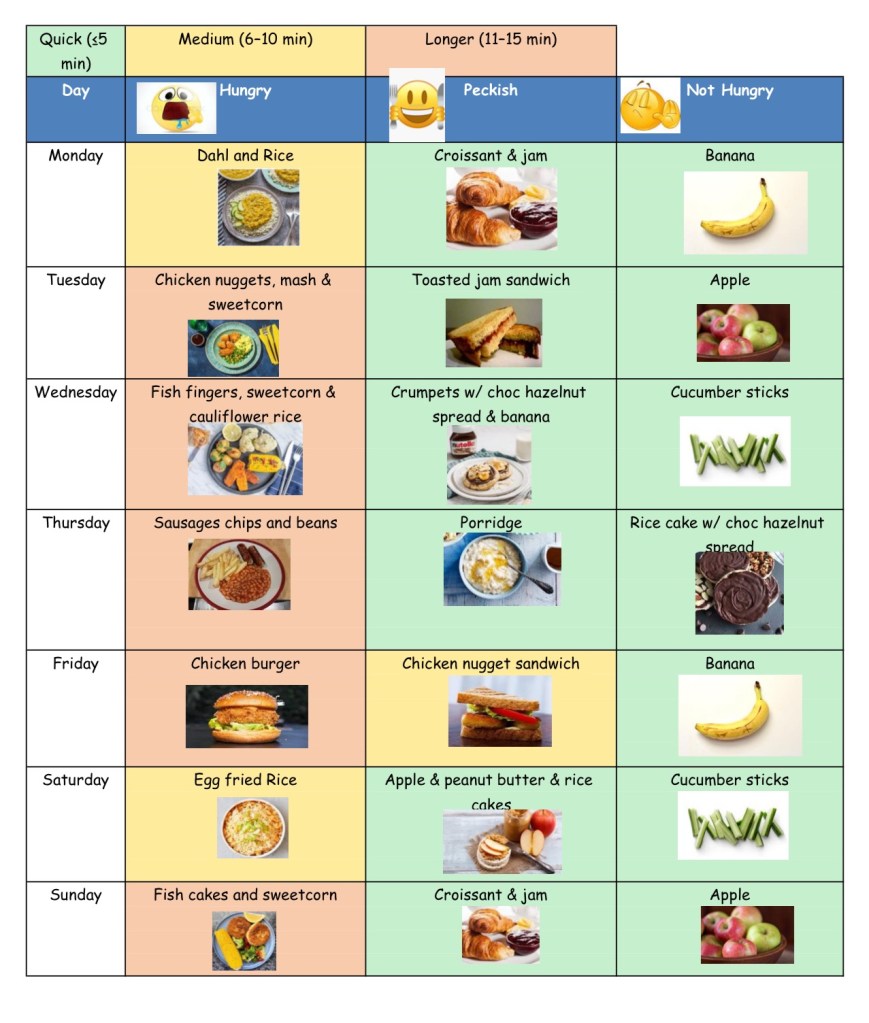
So now every day has three options: one for hungry, one for peckish, and one for not hungry. None of these are set in stone—if she fancies something else and we have it in stock, that’s fine. But I always make sure these meals are available. That way, if she doesn’t have the spoons to decide, we can point her at the list and she can just assess how hungry she is (something I can’t do for her).

We explained the idea to her, and she took to it like a duck to water (or like a fae child craving routine). In fact, she demanded to see the list before I’d even finished writing it! She now consults it every morning and muses over her options. Sometimes we edge her toward alternatives if we don’t have something or to make the choice more nutritious—but it works. No more meltdowns.

A few things to note:

The colour coding shows how long the meals take to cook. Red = up to 30 minutes (forever, if you’re a hungry seven-year-old). Yellow = up to 15 minutes. Green = no cooking at all (basically, “here—have a banana”). The pictures help her recognise what she’s being offered.

It took far too long to get the rota onto one page and printed (with the invaluable help of grandparents, who probably think we’re a little potty at this point). But since then? Not a single tantrum.

The new meal rota

Still… I can’t wait for school term to start again.

Social boundaries? …. Never heard of them

Social Boundaries? Never Heard of Her.

AKA: My Daughter Thinks Every Family Is Her Family

We’re in the gym club room. You know the type—soft play structure off to one side, clusters of parents slouched around coffee cups, the air tinged with a mix of sweat, fabric softener, and crushed oat bar. Most children, by some unwritten code, stick to their zones: from their own grown-ups to the play equipment and back again, like tiny commuter trains running predictable lines.

And then there’s my daughter.

She doesn’t do zones.

She happens to the room.

First, she charges into the soft play like it owes her rent, makes her rounds, climbs something she probably shouldn’t, then—just as suddenly—reappears. But not to return to me. Oh no. That would be far too linear.

Instead, she begins what I now call her Outreach Phase.

She drifts toward unfamiliar families with the confidence of someone who owns a clipboard and a lanyard. No hesitation. No preamble. She’ll crouch next to a mum like they’ve known each other since antenatal class, or start a full conversation with someone’s dad about whatever thought is currently pinging in her brain.

She never introduces herself, she assumes because she knows who she is they do as well. She just starts being there, part of the group.

Then she finds an empty table. Claims it. As if it’s been waiting for her. She lays out invisible blueprints, arranges chairs, waves at nearby children like a benevolent host welcoming guests to her exclusive club.

Children come. Of course they do.

She’s magnetic. They don’t know why they’re sitting down, only that she said so, and now here they are, part of something that did not exist five minutes ago and somehow feels like it always should have.

Meanwhile, I sit to the side, quietly watching. Not intervening. Not even surprised anymore.

If we dare bring up food at this point—she’ll wander over, take a bite, and vanish again mid-chew. Like a passing monarch, too busy for more than a nibble. Her table, her court, her people await.

Other parents glance over sometimes. I offer a sheepish smile, ready to leap in with a retrieval mission if needed, but they usually just smile back—equal parts bewildered and entertained. Some look relieved. (“Thank God someone else’s kid is weird.”)

And yes, it’s a little chaotic. A little boundary-less. A little oh please don’t lick that at times.

But it’s also magic.

I used to feel the need to tug her back, rein her in, whisper apologies and redirect her to our table. But over time, I’ve stopped. Because I realized this isn’t her being rude. This is her being exactly who she is—limitless in her curiosity, unafraid of strangers, entirely uninterested in conventional social rules.

She doesn’t cling. She connects.

She believes every space is hers to fill, every person a potential friend. She doesn’t see categories: family, stranger, mine, theirs. She sees people. Opportunities. Rooms full of possibility.

Yes, one day she’ll need to learn boundaries. She’ll need to recognize when to pause, wait, check in. But that can come. That can be taught maybe… or not maybe she’ll be a politician. 

What can’t be taught is this fierce joy in humanity. This ability to enter a space and belong to it without hesitation. To take an empty table and make it a kingdom.

So for now, I’ll keep packing the oat bars. Keep watching from a distance. Keep offering apologetic thumbs-ups to baffled parents who suddenly find themselves hosting a small, sparkly diplomat.

Because the world doesn’t scare her.

And maybe—just maybe—it needs a little more of that.

Parenting the rule enforcer

Our daughter has an interesting relationship with rules. They fall into two categories: if the rule is explained and it makes sense to her, she will not only obey it religiously, she will enforce it with others. And by others, I mean anyone within the general vicinity. It doesn’t matter who you are—teacher, parent, complete stranger—if it’s a rule she agrees with, it will be rigorously applied.

If it’s a rule she doesn’t agree with, then it will be ignored completely, regardless of consequence. This has led to some highly frustrating conversations and arguments where I’ve felt like I’m banging my head against a brick wall.

For example: yes, I know that neither Daddy nor Mummy has to travel in the back of the car or on a booster seat, but the law requires that anyone under the age of 12 or under 135 cm does so, and as such, you have to. No, we don’t have any say in the matter—neither do you. I know you don’t agree and don’t understand that the efficacy of the seatbelt is affected by the height of the passenger, and I have no way of demonstrating this that won’t lead to significant therapy bills in the future. Can you take my word for it? Of course not. So, every journey is a fight—until she was finally tall enough not to require the sodding thing.

Conversely: “Why are we travelling slower in the wet?” Well, it’s been a while since it rained; the water brings the oil to the surface in the form of rainbows that you can see, and this makes the road more slick and the car more likely to skid. So now, she will shout at anyone doing over 20 mph in the rain—regardless of the amount of rain, the condition of the road, or the fact that the speed limit is actually 70 mph.

She has also tried to make other cars obey her rules, regardless of whether they can hear her or not.

It’s caused meltdowns and tantrums in sports clubs because what is obvious to her as a blatant foul has not been caught by the group leader, and so other kids haven’t been sanctioned. These kids are between 6 and 11, but telling her to get over it would not go well. The “it’s just a game” argument does not compute, nor does “there isn’t a prize, it isn’t a competition.”

So we now think very carefully about any rules we introduce, because the phrase “hoisted by our own petard” will be inscribed on our gravestones. And for someone who can’t remember where she left her shoes, she has the mind of a steel trap when it comes to rules and routines.

Also, swear words—she can’t say “Mummy” and “Daddy” to the right person consistently, but she has learned the correct context for “for f**k’s sake.”

Direct payment part 2

So, a while ago, we got approved for 8 hours a week (school holidays only) direct payment for someone to look after our child. This means that I can get the washing and food prep for the week done without losing my mind. It also gives her a chance to interact with adults that are not myself or her father.

Like most things that are under the remit of local or central government, it is reviewed on a regular basis. Just to make sure that she hasn’t ‘grown out’ of autism, I guess?

At this last review (which was over three months ago) I was asked what we do to manage her endless energy and need for activity and stimulation during the term. I showed her case worker the number of clubs and activities that she is signed into at the gym. She blinked at me and sarcastically asked if that was all. When I said no, and that she also swam, spent time in the soft play area, and generally wasn’t back in the house until 6pm after school every single night, plus we spent at least 4 hours every Saturday and Sunday there so she could blast around the soft play, her jaw metaphorically hit the floor.

She asked how much it cost. I admit it’s expensive, we pay a lot for the privilege of wearing her out. Somewhere in the region of £400 a month for all of us, including her swimming lessons. Then something amazing happened. 

“I will see what we can do. If nothing else, it’s a no-brainer that we should cover part of her membership.” 

To my amazement, this month I received a phone call stating that it had taken time because it was unusual, but the panel had agreed! They will pay £100 a month toward her membership because, frankly, it’s cheaper than “kid’s clubs” every week, and she is doing more than a couple of hours a week there (ya think?!)

So, the moral of the story is, talk through your options because every now and then people will be on your side and help you if the choice is logical. And, as they say, every little helps.

Why is it so hard to get help

Our fae is – undeniably – autistic. My husband and I are not diagnosed, but we’re something spicy. We thought about getting diagnosed as an act of solidarity, and were told the waiting list in our area for adults to be seen is 10 years.

10. Years.

That’s insane. I was thinking about going back to work in that time, but as I need ear defenders (for all those looking for discreet ones I recommend Loop ear plugs) to sit in a cafe, and I can’t be under fluorescent lights without a migraine, the possibility of working in a school lab without a diagnosis to allow ‘reasonable’ accommodations is not going to happen. 

We also, having spoken to her teachers, are trying to get her on the pathway to an ADHD referral. I know there is a lot of crossover, and it may be her masking that is causing the signs, but she has expressed an interest in being either a teacher, a vet or an astronaut in the future. As all these career paths will require further and higher education, she will need to be able to do exams, and that is something where accommodations such as extra time/readers/scribes and – dare I say it – medication may help. She will not get the correct support without the correct diagnosis. 

At present, it’s at least a 2 year wait time for a referral so we thought we’d better start now. I went to my local GP reception and was told ‘Fill in an e-consult’ – so I did. The response on that was: do the self referral on child services and then give me the code. 

What child services??? What code? 

When I asked I was told all the information was in the message and the chat shut down. 

I went to the NHS website, and it said ‘contact your GP’. 

Err…

WTF where do I go from here?! Why is it impossible to start? I can’t even get an appointment to talk to a human, let alone truly start this ridiculous process. 

I am frustrated and remembering why we pay for private medical insurance. It’s a shame it doesn’t cover the assessment. I get the impression the NHS is doing everything in its power to force people to pay for private assessments.

Anyone got a spare £10k?!

Those who should know better

There are a set of individuals I feel should really know better than to expect standard behaviours from fae children. I take that back: there are TWO professions in which I expect this, namely education, where you need to understand at least in broad strokes the needs and differences to impart information; and those in the health care industry. 

Teachers and medics. So it is with great frustration that I continually run up against both who either don’t have a clue, or are operating on outdated or stereotypical data. It drives me insane. This has been driven home recently as I have been trying to get my daughter some medical help. It’s nothing serious, worst case she has a UTI.

The problem is that to diagnose this she needs to have a urine sample taken. Actually, back up: first she needs to talk to a GP. This is something she has no interest in doing. When I articulate to the GP that she is spectrum and that she is not going to do well with strangers they nod dismissively. Then ask her a question. Then they act surprised when she screams and runs out the room. 

No, typical children probably don’t do this, but my daughter is not typical: I just said that. Then they look at me as though I was supposed to stop her. No, I’m not going to traumatise her because you didn’t listen. When I tell them her symptoms they nod, agree UTI and then ask for a urine sample…the child ran out the room when you spoke to her but now you want me to get her to pee in a pot?!

Well, having talked to other SEND parents (top tip – other parents are the best source of info because the professionals have no idea) there are two options – sterile container and decant, or pads. The pads may seem like the best option but have the lifespan of two hours. 

So, all in all, it’s not easy. And that’s without the added complication of coercing cooperation out of your child. 

I dread the day they tell me they need to do an examination – that may require sedation.

Managing residential

This week, my daughter went on her first “sort of” residential trip with the school. How was it “sort of” residential, I hear you ask (all 2 people who are maybe reading this outside my immediate family) Well, it goes like this. 

A couple of months ago a very bubbly, slightly demented child came home from school brandishing a letter. The letter explained that they want to take the class to an adventure centre for three days in July. At the centre, there would be rock climbing, archery, canoeing and a whole host of activities that seemed to be the things our fae child thrived on.

The only problem being it was two nights away from home and our 7 year old has never stayed away from us overnight – ever. Not even with relatives. Not only that, but as written in a previous post, her bedtime routine is over two hours long, starts at 6pm and if not followed will result in said child not sleeping for a month. She also ‘follows her own agenda’ which in this case means she would see no problem, on waking at 3am, in getting herself up and taking herself off to the nearest climbing platform or canoeing lake and having a go alone. After all, safety lines are optional extras in her world, and having done it once she would deem herself an expert. 

All in all, the idea of her sleeping there was not something we wanted to contemplate. Which was sad, because she would love doing everything. Then we thought about it: how far away was the centre? As it turned out it was only about 20 mins away from us, no further than her school. So, with some negotiation, we agreed with the staff that we would drop her off every morning and collect her every evening. Not ideal, but the best solution we could come up with. The teachers gave me looks like I was an overprotective helicopter mother. Every parent I talked to seemed to agree that 7 is very young to stay out on a school residential trip even for a neurotypical child, let alone one who is frequently scared by Paw Patrol and only learnt to talk two years ago.

So, since Wednesday, we have been making the journeys to drop off and collect from the centre. On the plus side, the journey is significantly nicer than the school run – through the Yorkshire Moors and with little traffic. On the downside, bringing an over tired, cranky child home is a trial. 

She enjoyed her time, however, which I guess is the main thing. And we got some extra time, so a few chores that had been looming like the sword of Demoncles have been dealt with. 

Best of all, it’s over now. 

Trying new things

This coming week my daughter is trying several new things. I am aware that new experiences are essential to growth and development and no child can live in a bubble without them. That said these are milestones that I am not happy about her facing right now. 

Her school wants to take her on a residential trip. She is 7, this to me is young even for a neuro-typical child, especially one that has never slept out of the family home without a parent and for one that is divergent and is statemented as delayed way too soon. When I voiced my concerns to her teachers they looked at me as though I was insane and in the end I had to break it down to the point where I had to explain the whole of her night time routine to them (see previous post). 

Add to that she would be expected to eat strange foods, shower herself and have limited supervision at night when I know she will get anxious and go wondering and a compromise needed to be found. So I have agreed that she will attend during the days and we will collect her each night after my husband finishes work so she can still have her evening routine with us. We are fortunate that the outdoor pursuit site she is visiting is around a 20 minute drive. 

To try and get her ready for sleeping out, away from us we are starting with stage one. We are going to a hotel this weekend for one night. Another source of anxiety for me, it wasn’t planned that these two event would happen in the same week it was how the cards fell. I am concerned that this is not something that will go well. We have one room for the three of us, I am not convinced the hotel will give her an actual bed. Hell I don’t sleep in a bed when I had to share with my husband in the past so this is already looking like it will be stressful. I don’t like feeling like we are setting her up for failure but she needs new experiences and who knows she may love it.

So now I’m not sleeping because I’m anxious about the weekend going badly and I’m anxious about the school trip. I’m not convinced this week is going to be easy and the last time we were away from home it took a month for her to regulate when we returned so I’m not looking forward to that either. 

Oh and Summer holiday is looming like the demon of Christmas future. 

Can it be September again? 

Ignorance is bliss

Ignorance is bliss. It’s also a good tactic when dealing with truculent, self-opinionated and tantruming children. Following on from my last post on self-awareness, our fae has upped the ante on her behaviour and has decided that she is a ‘hunter’ and that hunters ‘do what they want’

This is an interesting concept from someone who needs help with everything from getting to school to wiping their ass, but we will gloss over that. She is adamant that she will loudly proclaim that she doesn’t need to listen to either of her parents and that we are in fact losers. 

You know the adage ‘never argue with an idiot because they will drag you down to their level and then beat you with experience?’ That can also be applied to small children. There is no winning, applying logic will not help you beauce they are not logical beings. Appealing to their better nature won’t work simply because they don’t have one, they are in fact little arseholes designed to test how far you can be pushed before you commit murder. 

So that left us with one last option: we ignore her tantrums. We sat down at the table having informed her that her food was ready and desperately wracked our brains for anything and everything we could talk about that didn’t revolve around her. This was not an easy task, my husband works from home and we had discussed his recent achievements at lunch. Nor did we have anything to talk about from my end, because I spend my days looking after the child and preventing her from killing herself, and yes this is a full-time occupation. 

After a minute she joined us, after two she started eating, after three she tried to join in the conversation and actually told us about her day (miracle of miracles). A much calmer evening than we have had in a long time. So ignorance may be bliss but ignoring is pretty tranquil as well.